
Plant Cell Diagram Labeled
Plant cells share most of their parts with animal cells, but they also have three features animal cells lack: a cellulose cell wall, chloroplasts for photosynthesis and a large central vacuole. This interactive labeled diagram shows every main part. Click a structure to read what it does, highlight the plant-only parts, switch off the labels to revise, or try the quiz.
- Free to use
- No sign-up
- Runs in your browser
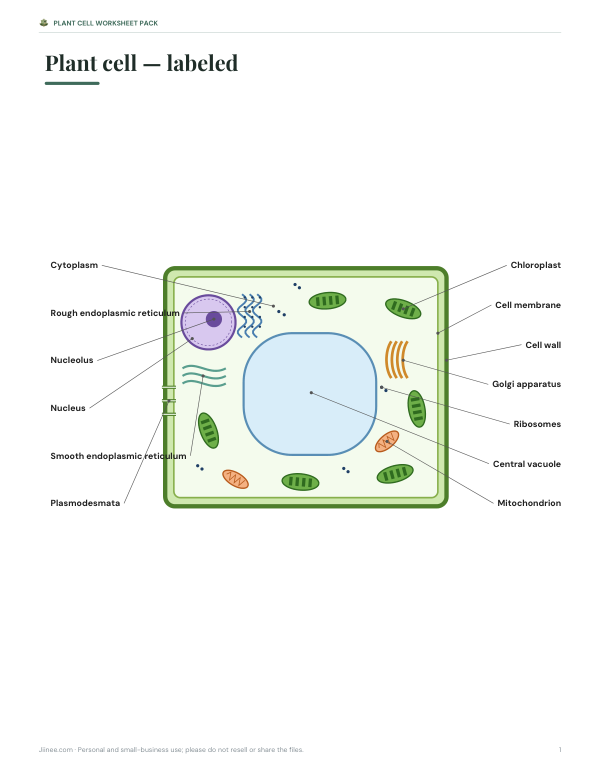
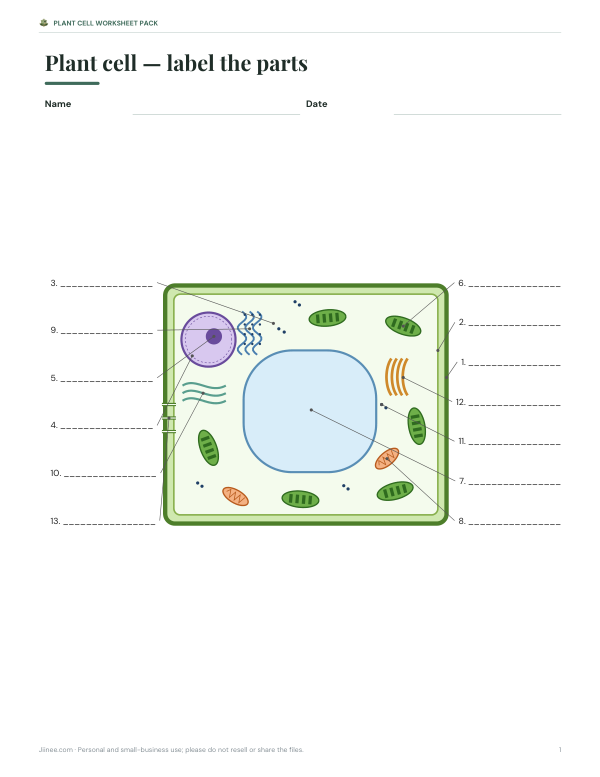
Interactive plant cell
Plant Cell Worksheet Pack
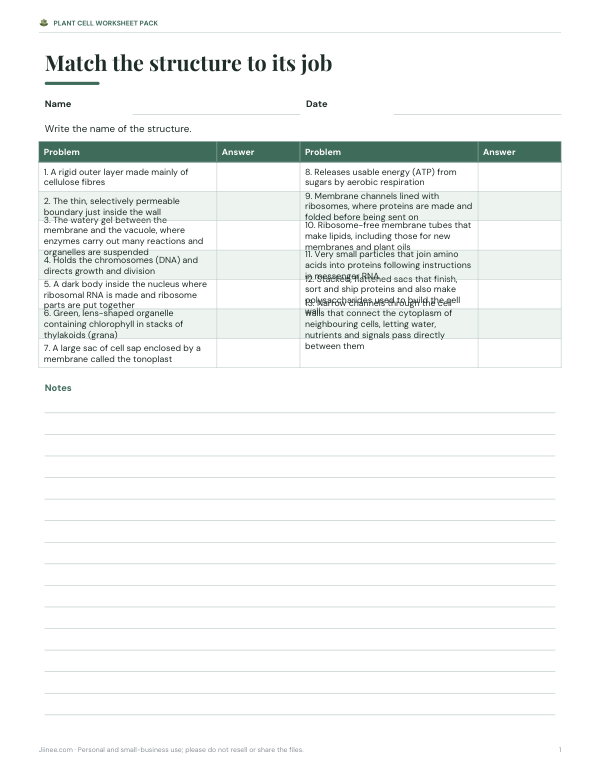
Plant cell printables with answer keys: labeled diagram, blank numbered diagram, plant vs animal cell comparison, organelle function matching and a microscope practical sheet.
- Labeled diagram (PDF)
- Blank diagram (PDF)
- Function matching (PDF, DOCX)
- Comparison (PDF/DOCX)
- Microscope practical (PDF, DOCX)
Formats: PDF, DOCX. Instant download after payment (link valid 72 hours, up to 5 downloads). AI-assisted: the templates were drafted with AI help and reviewed and laid out before publishing.
$4.00 USD, one-time 5 files · about $0.80 each
- Instant download
- 7-day refund
- Secure checkout by Stripe
7-day money-back guarantee. Full refund within 7 days of purchase, even after you download.
Free sample: Onion Cell Practical (PDF, 62 KB)
Full refund within 7 days — see the refund policy and license.
Free printables
Single sheets you can print right now, no sign-up. The full pack adds every sheet in one download plus the editable files.
 Printable Plant Cell Comparison Chart
 Printable Onion Cell Microscope Practical
Parts of a plant cell and what they do
| Structure | Function | Also in animal cells? |
|---|---|---|
| Cell wall | A rigid outer layer made mainly of cellulose fibres. It gives the plant cell its fixed shape, resists bursting when the cell takes in water and lets plants stand upright. | No |
| Cell membrane | The thin, selectively permeable boundary just inside the wall. Proteins in the membrane pump and channel water, ions and sugars in and out. | Yes |
| Cytoplasm | The watery gel between the membrane and the vacuole, where enzymes carry out many reactions and organelles are suspended. It streams around the cell in many plants. | Yes |
| Nucleus | Holds the chromosomes (DNA) and directs growth and division. In mature plant cells it is often pushed to one side by the vacuole. | Yes |
| Nucleolus | A dark body inside the nucleus where ribosomal RNA is made and ribosome parts are put together. | Yes |
| Chloroplast | Green, lens-shaped organelle containing chlorophyll in stacks of thylakoids (grana). It captures light energy to make glucose from carbon dioxide and water — photosynthesis. | No |
| Central vacuole | A large sac of cell sap enclosed by a membrane called the tonoplast. It stores water, sugars, salts and pigments, and presses outwards to keep the cell firm (turgid). | No |
| Mitochondrion | Releases usable energy (ATP) from sugars by aerobic respiration. Plant cells need mitochondria as well as chloroplasts, day and night. | Yes |
| Rough endoplasmic reticulum | Membrane channels lined with ribosomes, where proteins are made and folded before being sent on. | Yes |
| Smooth endoplasmic reticulum | Ribosome-free membrane tubes that make lipids, including those for new membranes and plant oils. | Yes |
| Ribosomes | Very small particles that join amino acids into proteins following instructions in messenger RNA. | Yes |
| Golgi apparatus | Stacked, flattened sacs that finish, sort and ship proteins and also make polysaccharides used to build the cell wall. | Yes |
| Plasmodesmata | Narrow channels through the cell walls that connect the cytoplasm of neighbouring cells, letting water, nutrients and signals pass directly between them. | No |
The three big differences
Most textbooks list three structures that set plant cells apart. The cell wall, made of cellulose, surrounds the membrane and gives support. Chloroplasts carry out photosynthesis, which is why leaf and stem cells look green. The large central vacuole can fill most of a mature cell, storing sap and keeping the cell pressurised. Plant cells also tend to have a regular, box-like shape, while animal cells are more rounded and flexible. Not every plant cell has chloroplasts — root cells and cells deep inside stems usually don’t, because they receive no light.
Photosynthesis in the chloroplast
Inside each chloroplast, stacks of disc-shaped thylakoids (grana) hold chlorophyll. Light energy absorbed there splits water, releasing oxygen, and produces energy carriers used in the fluid around the stacks (the stroma) to turn carbon dioxide into glucose. In words: carbon dioxide + water → glucose + oxygen, using light. The glucose is used for respiration in mitochondria, turned into starch for storage or into cellulose for new cell walls.
Turgor: why plants wilt
When a plant has plenty of water, the vacuole swells and pushes the cytoplasm and membrane against the wall. The wall pushes back, making the cell firm — this is turgor pressure, and it keeps leaves and young stems upright. When the plant loses more water than it takes in, vacuoles shrink, cells become flaccid and the plant wilts. In very salty conditions the membrane can pull away from the wall altogether, a process called plasmolysis, which students often observe in red onion cells.
How to use the interactive diagram
- Start in Labeled mode and click each structure to read its function.
- Tick “Highlight plant-only structures” to fade the parts plant and animal cells share.
- Switch to Numbered mode to hide the names and test yourself, or print it as a worksheet.
- Try “Spot the part”: one structure is highlighted and you pick its name.
- The function quiz gives a description and asks which structure it belongs to.
Worked example: revising for a test
A student has a quiz on cell structure. They read through the labeled diagram, then use the highlight option to remember the four plant-only structures. In “Spot the part” they score 8 out of 12, mixing up the Golgi apparatus with the rough ER. After re-reading both functions they print the numbered diagram, fill it in from memory, and check it against the labeled version.
Seeing plant cells under a microscope
Onion epidermis and pondweed (Elodea) leaves are classic school specimens. Peel a thin layer of onion skin, lay it flat on a slide with a drop of iodine solution, add a coverslip and view at low power, then high power. You will see the brick-like walls and nuclei clearly; iodine stains starch blue-black and makes the nucleus stand out. Elodea leaves show green chloroplasts, which can often be seen moving as the cytoplasm streams. Ribosomes and ER are far too small to see with a light microscope.
Memory tricks
- Wall = Wood-like support; think of cellulose as the “bricks”.
- Chloroplasts are “chloro” — green, like chlorine gas is greenish.
- The vacuole is the water balloon that keeps the cell firm.
- Plasmodesmata are the “doorways” between neighbouring cells.
- Mitochondria are in plant cells too — plants respire all the time.
A note on diagrams
This is a simplified model, not to scale. Real plant cells vary: leaf palisade cells are packed with chloroplasts, root hair cells have a long extension and no chloroplasts, and xylem vessel cells are dead, hollow tubes. Use the diagram to learn the typical parts, then look at real specimens.
Frequently asked questions
What are the parts of a plant cell?
Cell wall, cell membrane, cytoplasm, nucleus, nucleolus, chloroplasts, central vacuole, mitochondria, endoplasmic reticulum, ribosomes, Golgi apparatus and plasmodesmata.
What is found in a plant cell but not an animal cell?
A cellulose cell wall, chloroplasts, a large central vacuole and plasmodesmata.
Do plant cells have mitochondria?
Yes, they need them for respiration.
What is the function of the cell wall?
It supports the cell, gives it shape and stops it bursting.
What does the vacuole do in a plant cell?
It stores cell sap and keeps the cell firm by turgor pressure.
Can I print a blank plant cell diagram?
Yes, choose Numbered mode and print.